Awards and Recognition
Tokyo Sports Grand Prix:
Match of the Year (Eight Times)
Wrestler of the Year (1996 and 1998)
Tag Team of the Year (1993, 1994, and 1999)
Rookie of the Year (1989)
Pro Wrestling Illustrated:
Ranked #33 Wrestler of the PWI Years in 2003
Wrestling Observer Awards:
Wrestling Observer Hall of Fame (Class of 2002)
23 Five Star Matches
Match of the Year (1992, 1998, 1999, 2003, 2004, and 2005)
Wrestler of the Year (1996, 2003, 2004, and 2005)
Tag Team of the Year (1995 and 1999)
Most Outstanding Wrestler (1993 and 1994)
|
Notable Matches
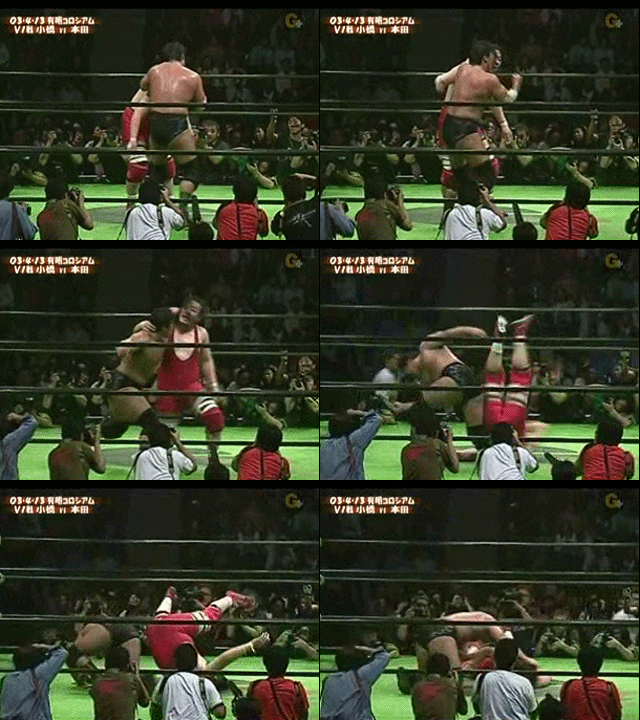
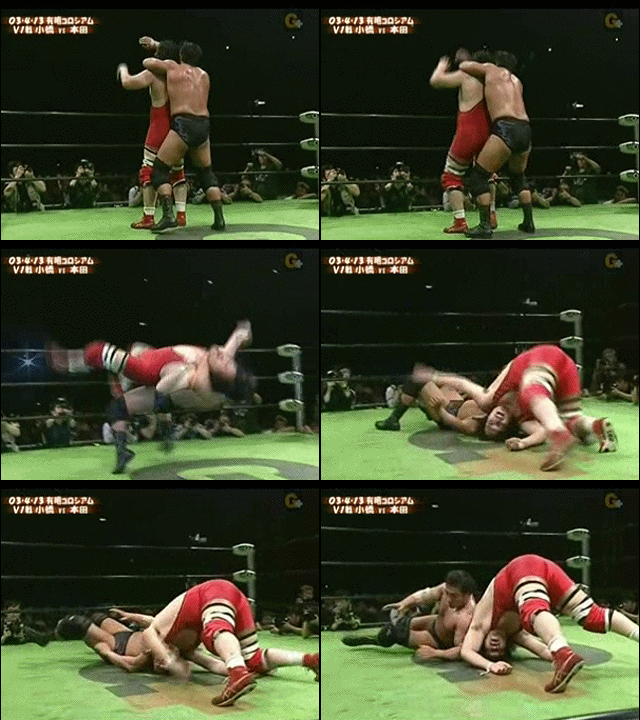
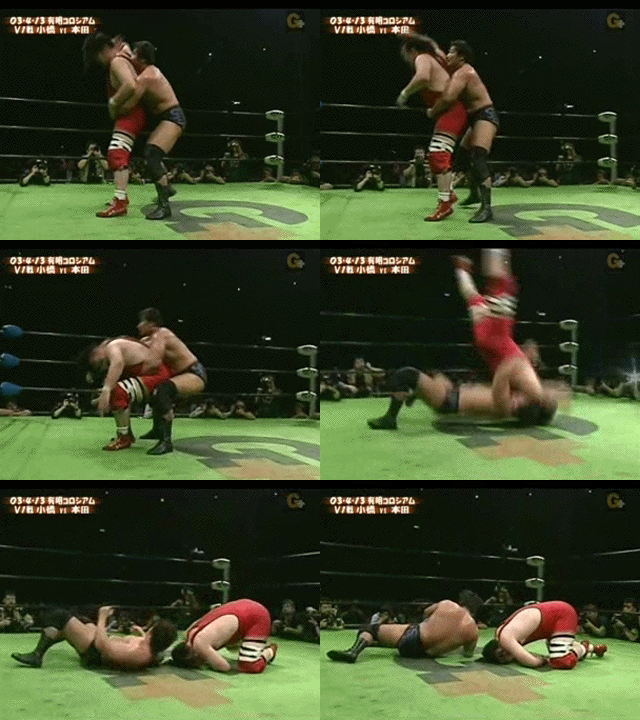
December 9th, 1995 with Misawa vs. Kawada and Akira Taue
July 24th, 1996 vs. Akira Taue
June 12th, 1998 vs. Toshiaki Kawada
March 1st, 2003 vs. Mitsuharu Misawa
July 18th, 2005 vs. Kensuke Sasaki |
Other Pictures
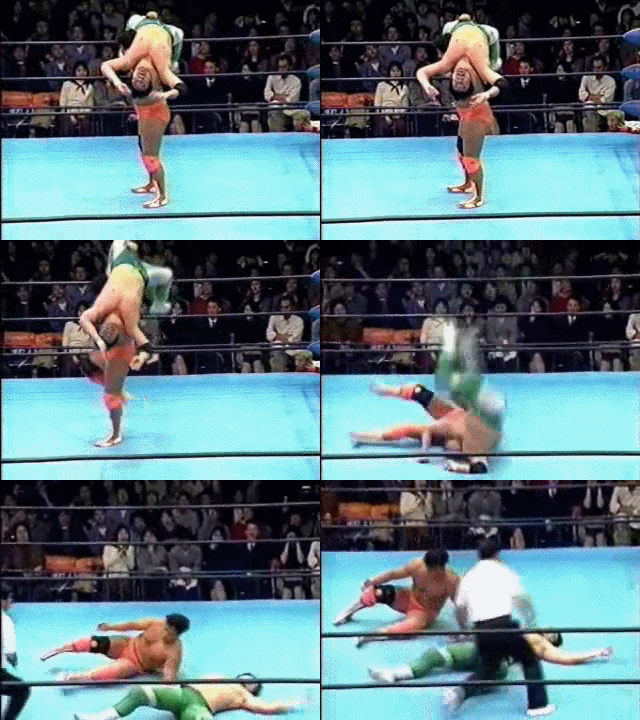
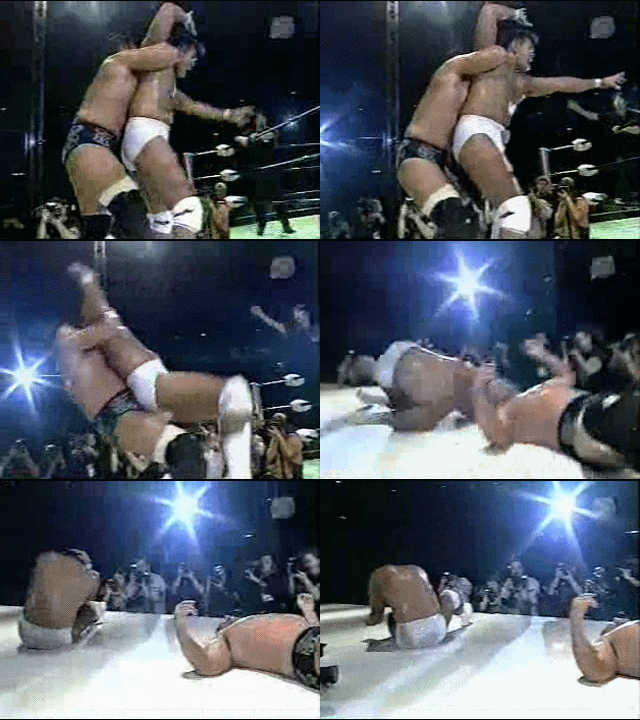
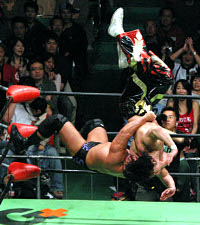
A Half-Nelson Suplex from the Top Turnbuckle
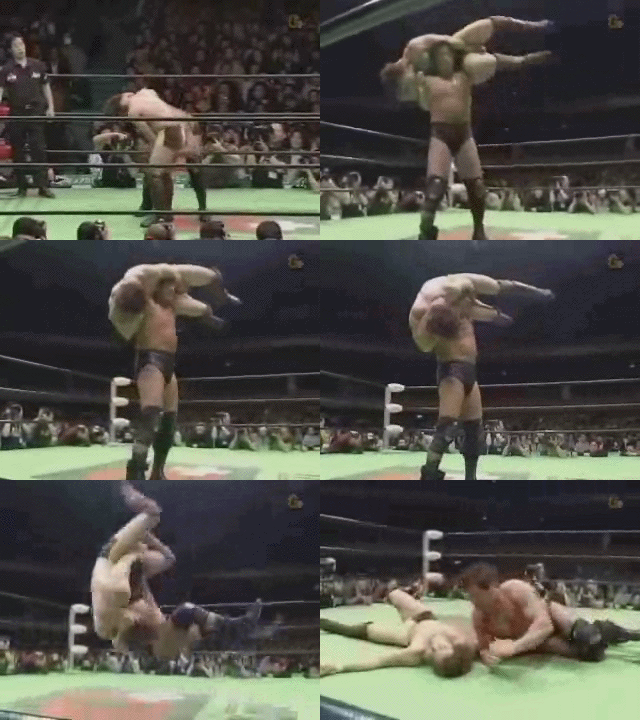
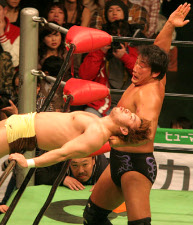
Kobashi gives KENTA the Burning Sword |
Career Recap:
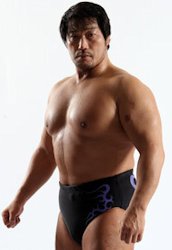
One of the most popular wrestlers in puroresu history, Kenta Kobashi would enter All Japan just as the old guard was fading and would lead them to become one of the most successful promotions in the 1990s. Through the 90s, Kobashi would prove that he was one of the most intense and talented wrestlers in the world, as he put on classic matches with wrestlers such as Stan Hansen, Mitsuharu Misawa, Toshiaki Kawada, Jun Akiyama, and many more. Kenta Kobashi also helped in the formation and success of a new promotion, as NOAH became one of the top Japanese promotions with Kobashi as their champion. Still wrestling today, there is little doubt that Kobashi is one of the greatest wrestlers still actively competing and with his Burning Spirit he is sure to continue dominating for many years to come.
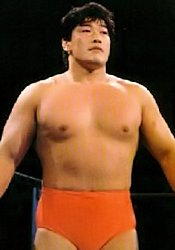
Debuting in 1988, Kenta Kobashi showed promise at a young age. As is the tradition in Japan, Kobashi did not immediately jump to the main event, but slowly worked his way up the card. After years of opening events and seconding the stars of All Japan, Kobashi finally won his first Championship in 1990 - the All Asian Tag Team Championship. While not the most prestigious Championship, it did allow him to have longer and more important matches on the cards and he quickly turned into a crowd favorite. Teaming with Johnny Ace, Kobashi dominated the mid-card, and it was only a matter of time until he moved into the main event picture.
During the early 90s, the face of All Japan was changing. Giant Baba was getting older, and he was no longer able to put on singles matches. Around that same time, Jumbo Tsuruta was diagnosed with Hepatitis, and he too was no longer able to actively wrestle as a main eventer. Luckily for All Japan, they had three wrestlers that were more then willing to carry on the workload: Kenta Kobashi, Mitsuharu Misawa, and Toshiaki Kawada. With Stan Hansen and Steve Williams' help, all three would become legitimate contenders for the Triple Crown Championship. By 1993, all three would have cemented themselves as the main faces of All Japan and they would continue to be for the next seven years.
Unfortunately, Kobashi did not immediately find success as a singles wrestler. In 1993 and 1994, he would suffer losses to both Williams and Hansen and for the time was still a step behind Misawa and Kawada. He didn't let it bother him though, and Kobashi continued finding success in the tag team division. With Misawa, he would win the Real World Tag League from 1993 to 1995 and hold the All Japan World Tag Team Championship a total of six times from 1993 to 1998.
Finally, Kobashi was able to win the Triple Crown for the first time when he defeated Akira Taue on July 24th, 1996. Even though he would drop the Championship to Misawa in a classic encounter six months later, Kobashi was no longer lagging behind his friend Misawa and his rival Kawada. Kobashi would defeat Kawada for the Triple Crown on June 12th, 1998... but again, it was Misawa who topped him and would regain the crown. In over eight years of encounters, Kobashi had not managed to pin Misawa's shoulders to the mat in a Championship match. Kobashi would one day beat Misawa for the Championship, but it would not happen for another five years.
In the meantime, Kobashi continued finding success in All Japan, as he would win the Triple Crown again from Vader in 2000. Kobashi would hold the Championship until June of 2000, when Japanese wrestling changed suddenly and dramatically. After Giant Baba (the founder and owner of All Japan) died in 1999, his wife Motoko Baba took the reigns of All Japan and began making changes that other wrestlers did not agree with. Misawa voiced his concerns, and in turn was demoted from the decision-making committee. This was the last straw, and so he and 23 other wrestlers from All Japan (including Kenta Kobashi) split off and formed a new promotion: Pro Wrestling NOAH. His old nemesis Kawada did not come with them, and Kobashi has not had a match against him since the split.
Misawa and Kobashi now had the daunting task of making a successful new promotion. Kobashi soon began a feud with Jun Akiyama, who had debuted almost 10 years prior and was considered a potential ace of NOAH. Akiyama and Kobashi had paired together in All Japan to twice win the All Japan Tag Team Championship, but now were pitted against each other. In the year 2000, both Akiyama and Kobashi would score victories over each other, and Akiyama was boosted up the card due to his encounters with Kobashi. This would end up being more important then originally thought, as the years of abuse on his body would finally catch up to Kobashi.
Throughout his career, and especially when he was younger, Kobashi used the moonsault as his finishing maneuver. As we now know (from both Kobashi and Mutoh), doing hundreds of moonsaults over 12 years can do terrible damage to a wrestler's knees. Kobashi was barely able to walk by early 2001, and he finally decided to have surgery. He would be out of action for over a year as he slowly healed. Finally, by late 2002, Kobashi was back in full form. On March 1st, 2003, Kobashi would get another shot at Misawa, and this time for the GHC Heavyweight Championship.
In what is considered by some one of the best matches of the decade, Kobashi would defeat Misawa for the GHC Heavyweight Championship when he delivered the Burning Hammer on Misawa. Kobashi would go on to hold the GHC Heavyweight Championship for over two years, defeating literally every major wrestler in NOAH. Along the way he had excellent matches against his old foes Akiyama and Taue, and also defeated some of the younger wrestlers such as Yoshinari Ogawa, Yuji Nagata, and Takeshi Rikio.
Kenta Kobashi started 2005 still as the GHC Heavyweight Championship, but lost the belt to Rikio in March. That would be the last time Kobashi's shoulders were pinned for the remainder of 2005. Mostly teaming with Go Shiozaki towards the middle of the card, the two put on excellent matches against all comers. At the July Dome Show, Kobashi defeated Kensuke Sasaki in an epic duel. Kobashi also traded chops with Tenryu on more then one occasion, setting up a possible singles match that unfortunately never happened. 2006 was a sad year for Kobashi, as in June a tumor was found on his kidney, forcing him to have major surgery. He recovered however and he announced that he will return to wrestling sometime in the future. Before his forced vacation, however, Kobashi was having a great year as he defeated both KENTA and Marufuji in singles matches. He also won the GHC Heavyweight Tag Team Championship with Honda, but he was forced to vacate it in the summer.
Kobashi spent the vast majority of 2007 recovering from the surgery to remove the tumor from his kidney. Finally, on December 2nd he would return, drawing the first sellout of the Budokan in 2007. After the match Kobashi said that he felt healthy and hopefully he will be able to return to a full time schedule in 2008. Kobashi was healthy for the bulk of 2009, but suffered another setback towards the end of the year. He did not participate in the Global Tag League but he did win the Global Hardcore Crown Openweight Championship from Makoto Hashi on June 8th. He successfully defended the title against Masao Inoue, Kishin Kawabata, Keith Walker, and Yuto Aijima. On September 27th, Kobashi teamed with Yoshihiro Takayama to defeat Akira Taue and Keiji Mutoh, and he made a rare New Japan appearance on October 12th where he teamed with Chono and Mutoh to defeat Manabu Nakanishi, Satoshi Kojima, and Jun Akiyama. In December it was announced that Kobashi would be sidelined with a myriad of injury issues.
After being in and out of NOAH for several years, Kobashi finally retired on May 11th, 2013. He had not wrestled regularly since early 2012, as injuries had caught up with him. After retiring, Kobashi began running his own wrestling events, and he will always be remembered as one of the best and most exciting wrestlers in the history of professional wrestling. |